DeJeonge Reese

Family Follicles
Family Follicles

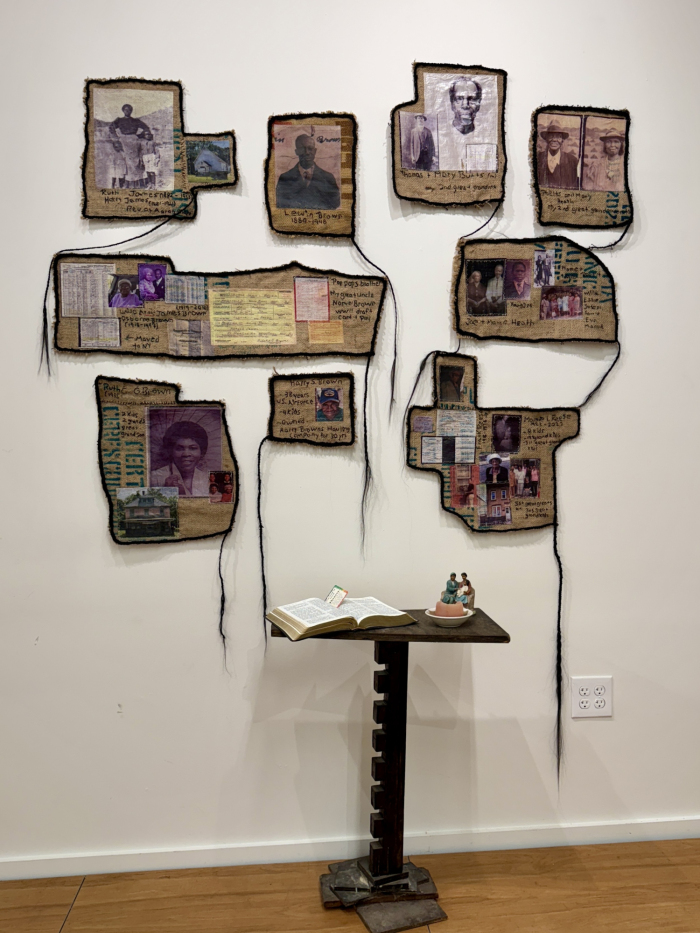
about 4ft x 5ft 10inches w, burlap, images, embroidery, synthetic hair, 2025

Handmade table, reclaimed wood, 1ft w,1ft 11inches long,2ft 10inches tall,2017

I’ve been researching my family tree for years, and this is the first time that work became physical.
The images span generations—my grandparents, their parents, and their grandparents—alongside census records, marriage licenses, and war registration cards.

The table in front was made by me in grad school from found and scrap wood.
It holds a candle, a small statue of a mother, grandmother, and child, and my late great-aunt’s Bible—opened to Psalm 23, a verse my grandmother made us recite every visit.

I wanted this to feel like a quiet corner of a family home.
An altar of memory, lineage, and labor.

I made two versions—one for my maternal side, one for my paternal side—
holding space for those who came before me and sharing their stories. 


Tignon Law
Tignon Law

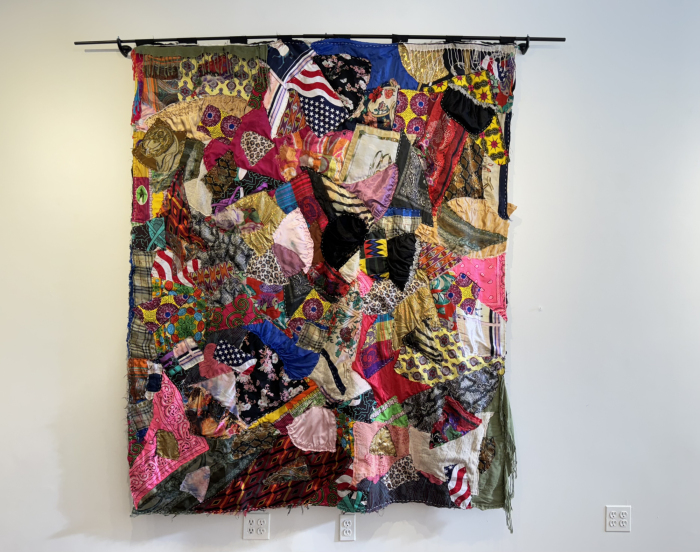
worn head wraps, scarves and bonnets  81.5 x 68 inches, 2024

Scarves and head wraps have been worn for centuries, carrying different meanings across cultures, faiths, and generations. For this piece, I was drawn to the complex role scarves have played in the lives of African American women. I began by reflecting on the 1786 Tignon Law in Louisiana, which made it illegal for Black women—enslaved or free—to wear their hair uncovered in public. The law was a tool of control, aimed at suppressing expressions of beauty and status deemed “too competitive” with white women. Yet, in resistance, our ancestors wrapped their hair in bold colors, intricate patterns, and masterful styles—turning an act of restriction into one of pride, creativity, and identity. Over time, the scarf became the Black woman’s best friend—offering protection from sun and wind in the fields, preserving intricate styles for Sunday service, and holding our hair (and our lives) together through countless moments. I kept thinking: how many stories are wrapped up in a scarf? The love made and lost. The meals cooked. The laughter shared. The quiet, everyday rituals. The early mornings and late nights. This quilt is a nod to that lineage—to the beauty, labor, memory, and resistance woven into every wrap, scarf, and bonnet. It honors the many stories carried within them, and the women who wore them.


A Familiar Terrain
A Familiar Terrain

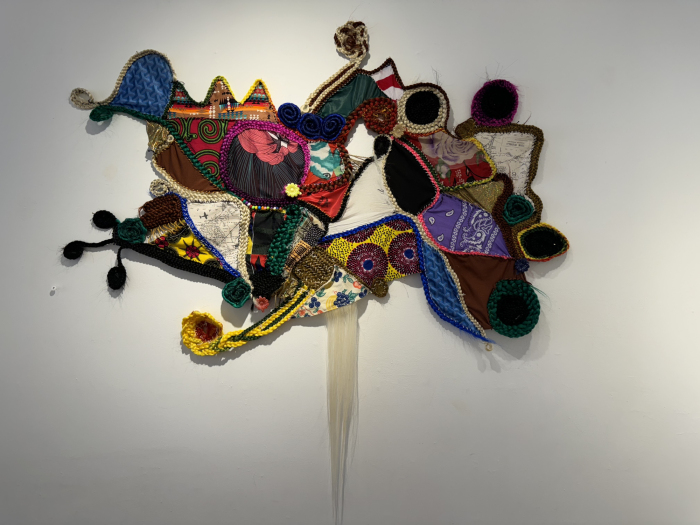
Synthetic hair, scrap fabric,  about 30in L x 35in W 2024


A Familiar Terrain draws from histories in which quilts and braiding functioned as systems of knowledge, guidance, and survival. Within African American traditions, quilts associated with the Underground Railroad are believed to have carried coded information—patterns that signaled resources, movement, and safe passage. Similarly, cornrows are understood as forms of embodied mapping, braided to hold routes, directions, and spatial memory. This abstract composition was created during my residency at the Virginia Center for the Creative Arts, located in the foothills of the Blue Ridge Mountains. VCCA occupies land that sits on the traditional territory of the Monacan Indian Nation. Learning that the center is located on land that was once Sweet Briar Plantation, later Sweet Briar College, worked by enslaved people, sharpened my attention to the land itself—as a site of labor, control, movement, and resistance. Constructed from synthetic hair and fabric scraps from worn headwraps and scarves, materials carried forward from my Tignon Law work, the piece forms an improvised terrain. In parallel to my Hair Map series, the work considers how Black hair and textiles function as cartographic tools, holding ancestral knowledge, cultural innovation, and strategies for survival.


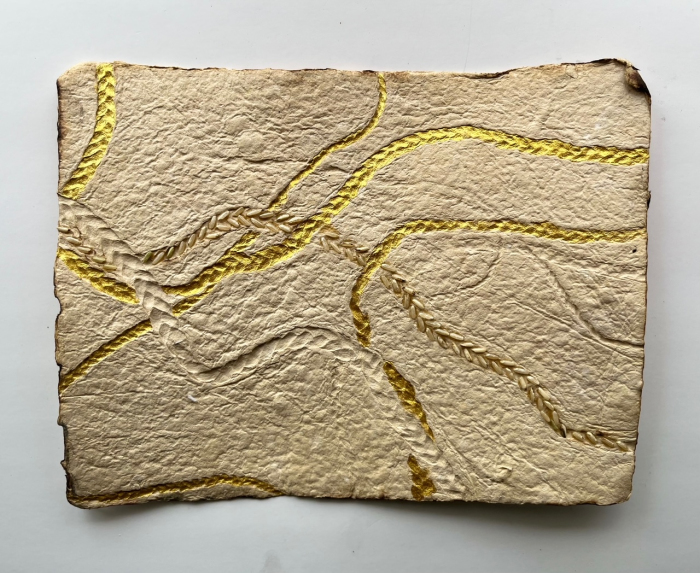
Hair Map Series #17 of 21

handmade paper,rice,gold ink,(8.5 x 11),2023

Grounded in historical and ancestral research as well as personal experience, my practice often bridges past and present. I draw from archival sources, oral histories, and family research, translating inherited knowledge into contemporary forms. Rather than presenting history as fixed or distant, I approach it as something embodied, carried, and continuously reshaped.